

Finding New Wallets: A Practical Guide
Learn where to find high-quality wallets to track, how to analyze trader behavior, and how to separate smart money from noise — with real examples and walkthroughs.
Your wallet watchlist should be updated regularly. The market evolves constantly — some traders disappear, new ones emerge, and those who once provided strong signals may go silent or become ineffective. So, the logical question is: where do you find new wallets, and how do you do it efficiently?
Let's break the search down into key categories:
🔍 Finding Top and Early Traders in Hyped Launches
This is one of the most valuable and productive types of wallet discovery. The goal is to identify traders who consistently enter projects early and profit reliably.
You can spot them by analyzing:
- Top Traders tabs
- Top Holders tabs
- Fresh pair listings
- Token purchase history or signs of early accumulation before visible growth
🎯 Targeted Search for a Specific User
Sometimes the goal is to track a particular individual — an influencer, a community member, or a trader tied to a specific token or event.
This could involve:
- Tracking wallet actions following social media posts
- Analyzing entries into tokens before/after announcements
- Identifying wallets managed by a single source of influence
These wallets are especially valuable when their owners know how to capture attention. One post — and the token comes to life. And you're already positioned.
🧩 Searching for Sub-Wallets
Most experienced traders operate multiple wallets. For example:
- One for storage
- One public (signal wallet)
- One private (trading wallet)
- One deposit (exchange wallet), etc.
To see the full picture, it's important to detect related addresses and track not just the main wallet, but also its "periphery."
🛠 Practice: How to Find New Wallets
Here are some effective methods you can use to regularly discover interesting wallets worth tracking.
Dexscreener: Finding Active Wallets Through Successful Tokens
One of the simplest and most effective ways to discover new, high-potential wallets is by analyzing who participated in early buys or accumulated a position near the lows of a token that has already gained attention.
Step 1: Choose a Token to Analyze
The first — and most important — step is selecting the right token around which you'll build your analysis.
The Ideal Candidate Is:
- A token that has already shown strong growth or is gaining attention in the crypto community
- An asset that supports a clear thesis — whether it's meme potential, influencer backing, a strong tech narrative, or a product with real-world utility
- A token that has survived its first 24 hours and is still trading actively
🕒 Why This Matters: Around 95% of new tokens "die" within the first 24 hours of launch. Trading these requires serious experience, insider knowledge — or pure luck. If a token stays alive beyond the first day, that alone is a filter. It signals potential real interest behind the project — and within the early buyers, there may be wallets worth tracking.
❗ What to Avoid: Don't randomly pick a token that's pumping without understanding why. Artificial pumps may look exciting, but more often than not they end in losses — with only the token creators and a handful of sharp traders walking away with profit.
📌 Pro Tip: If you understand why traders are buying a token, you can backtrack and find out who bought early. And those wallets become your new signal sources.
Example: $IMAGINE
Let's take the token $IMAGINE (EuU9Vh37eKDdUnZkUfMZLGCcBqwFYpr1E6X3ZwUxhvgm), which delivered an excellent performance.
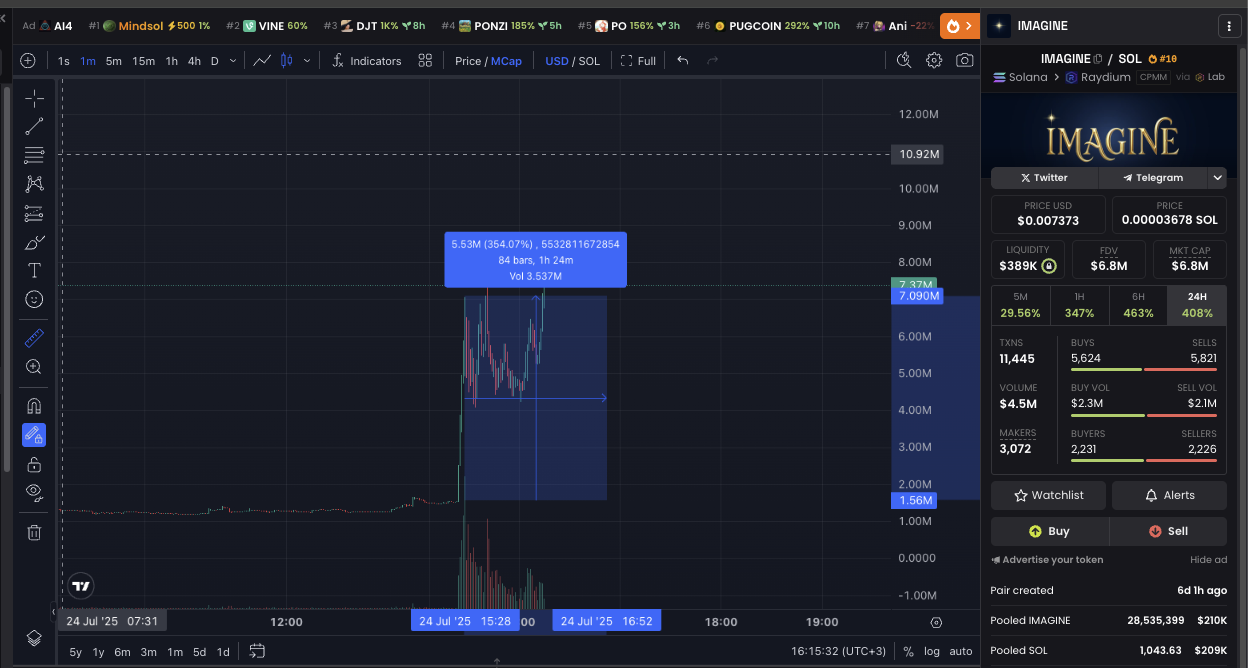
Now let's break down why it happened:
🧩 Narrative Boost — Rumors started circulating that @elonmusk was preparing to launch a new short-form AI video product — something in the style of Vine. The word "Imagine" fits perfectly into the kind of prompts used in Grok and other generative AI tools, giving the token narrative weight and making it more "memeable."
📢 Musk's Tweet — After a tweet from Elon Musk himself, interest exploded — the token saw massive traction.
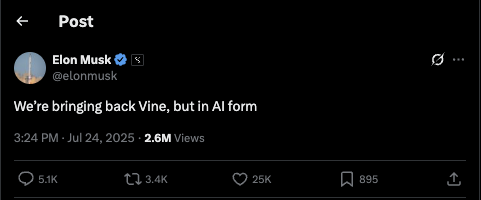
✍️ Early Trader Signals — A few seasoned traders started talking about the token before the pump, and you could observe their wallets beginning to scale into positions. This was the first clear signal — confident entry behavior from known wallets with a history of success.
📈 Real-Time Detection via RayBot — RayBot could have picked up on this interest early, allowing for timely analysis and entry. Even if you missed the initial move, $IMAGINE is still a great case study for reverse analysis — a way to find high-quality wallets that entered early, with a clear thesis and a strong reaction to narrative momentum.
Step 2: You've Chosen the Token — Now Start the Analysis
Once you've selected a token, your next goal is to identify the wallets that:
- Entered early, before the price began to rise
- Accumulated volume near the lows, ignoring the noise
- Made large buys at key moments — before a reversal or just ahead of an impulse move
- Most importantly: closed in solid profit
These are the wallets representing what's often called "smart money" — traders who know how to find liquidity, react quickly to market shifts, and make consistently profitable decisions.
Open the Top Traders tab on Dexscreener and review the list of active traders. Then review each participant's TXNS to manually analyze their behavior:
- A) Single large buys, especially if made near the lows on the chart. This often points to a confident entry based on a clear thesis.
- B) Gradual accumulation of the token at low levels. This suggests a strategic and planned approach, rather than impulsive trading.
Who's Not of Interest:
🔪 Scalpers — traders who jump into every pump & dump and instantly take profits are usually not valuable for long-term tracking. Their behavior is unstable, their signals noisy, and their actions rarely reflect a well-formed thesis.
🎯 Snipers — wallets that enter tokens in the first few blocks. These are typically part of automated spray-and-pray strategies that deploy capital across hundreds of tokens, hoping one or two will deliver outsized returns.
Showcase 1: Good Wallet
Step 1: Start with Dexscreener
EFqaGUqEtoSqz4FZF7Kgf9p8VYAH8WN9vqrkF9E4nx2K — a textbook example of a well-executed trade: entry near the lows, steady position holding, and profit-taking at a key breakout point.
Summary:
- Invested: around $15,000
- Profit: approximately $45,000
- Timing was precise and deliberate
- The trade showed confidence and strategic intent
This wallet is a strong candidate for further tracking: review its behavior across other tokens, analyze its full history via external trackers, and if repeatable patterns are found — add it to your RayBot watchlist.
Step 2: Check in GMGN.AI

Based on GMGN's activity history, the trader interacted with only 10 tokens over the last 7 days, and 22 over the last 30 days — indicating a selective, non-reactionary approach.
Notable Successful Trades: Tokens like $IMAGINE, $STARTUP, $DEBT, and a few others stand out — early entries and confident profit-taking are clearly visible.
Key Observations:
- In strong projects, they tend to enter with high size
- In more speculative/gambling plays, they're cautious and reduce size
- There are some mistakes with large positions, showing they're not always right — so blindly copying is not advisable
💡 Conclusion: This wallet is definitely worth adding to your watchlist. It's a valuable signal source, but not a blueprint for action. Their activity can serve as a trigger to conduct your own research on the token, or as additional confirmation when the same token appears across multiple credible wallets.
Showcase 2: Bad Wallet
j1opmdubY84LUeidrPCsSGskTCYmeJVzds1UWm6nngb — wallet ranked #45 in the Top Traders list.
At first glance, it looks like a perfect candidate:
- Bought for $305
- Sold for $11,500
💡 But this is a trap. Before adding any wallet to RayBot, you must analyze it carefully.
Check the Balance column in Dexscreener — it's marked as Unknown, which means the amount of tokens sold doesn't match the amount purchased. Some tokens may have been transferred from another address.
📌 Conclusion: Don't rush to add a wallet based on numbers alone. You must run a basic background check first.
Deeper Analysis on GMGN.AI
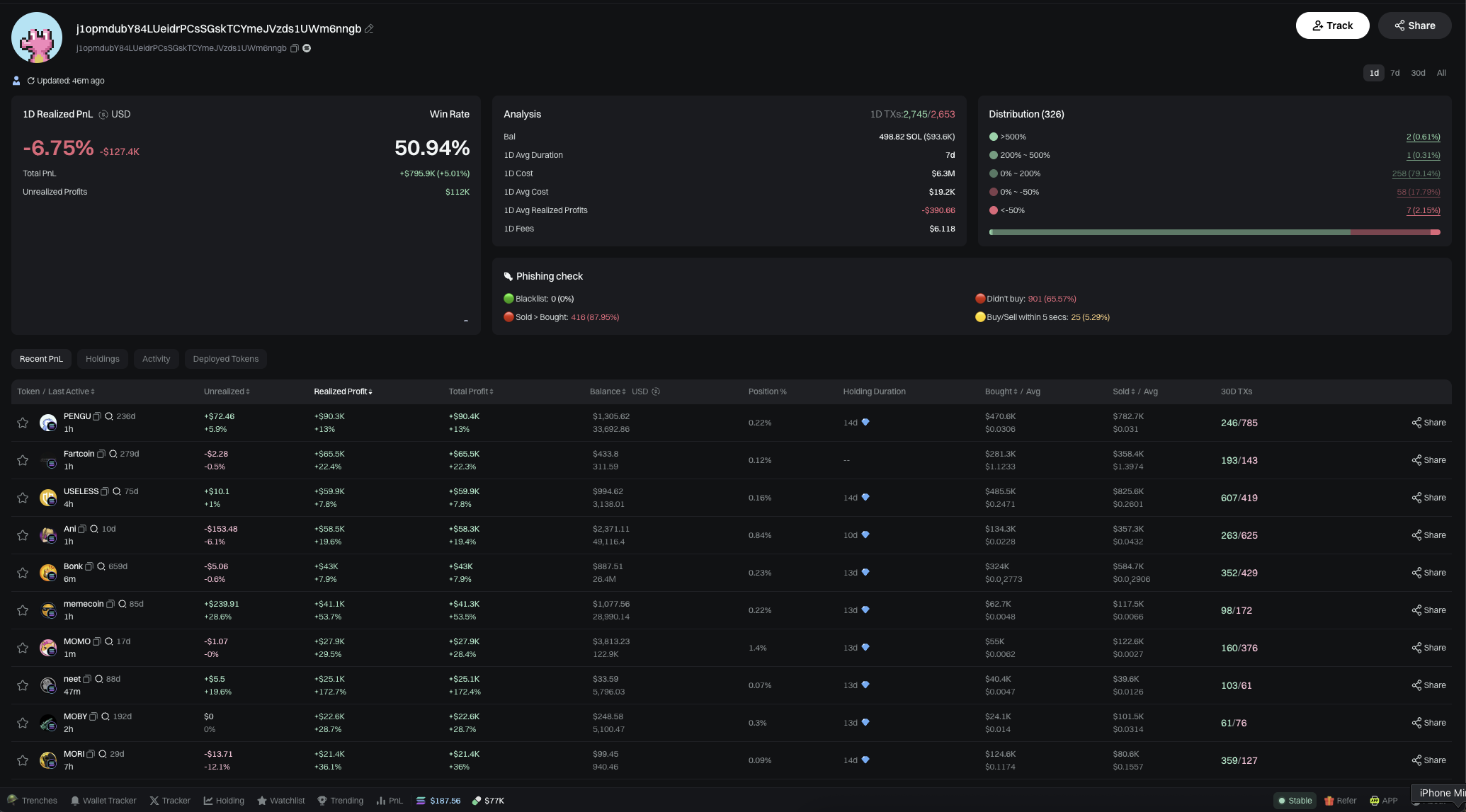
🔻 The Danger of Profit Illusion — You see a wallet's profit and think, "This is a goldmine!" — but that can be a critical mistake.
In this case, there's a major red flag: the number of transactions. This wallet made 326 transactions in a single day. That's almost certainly a trading bot.
Why This Is a Problem:
- It's impossible to manually track its behavior
- In Multi Buy, it will show up in every trade, clogging your feed
- Tracking it separately is pointless and inefficient
Conclusion: Despite the impressive numbers, this wallet goes straight to the trash bin.
📌 Pro Tip: GMGN.AI lets you tag wallets — make use of this feature. It allows you to avoid rechecking the same addresses, mark wallets as either trash or high-potential, and save time by not analyzing the same wallet twice. One tag — and you'll never waste time on it again.
Advanced: Chart Zone Analysis
Now we're going deeper — into filtering and manual analysis, to uncover truly strong and intentional traders.
Some traders intentionally split their actions across multiple wallets — buying from one, selling through another — to stay off the radar in Top Traders. That's why it's crucial to look beyond surface data.
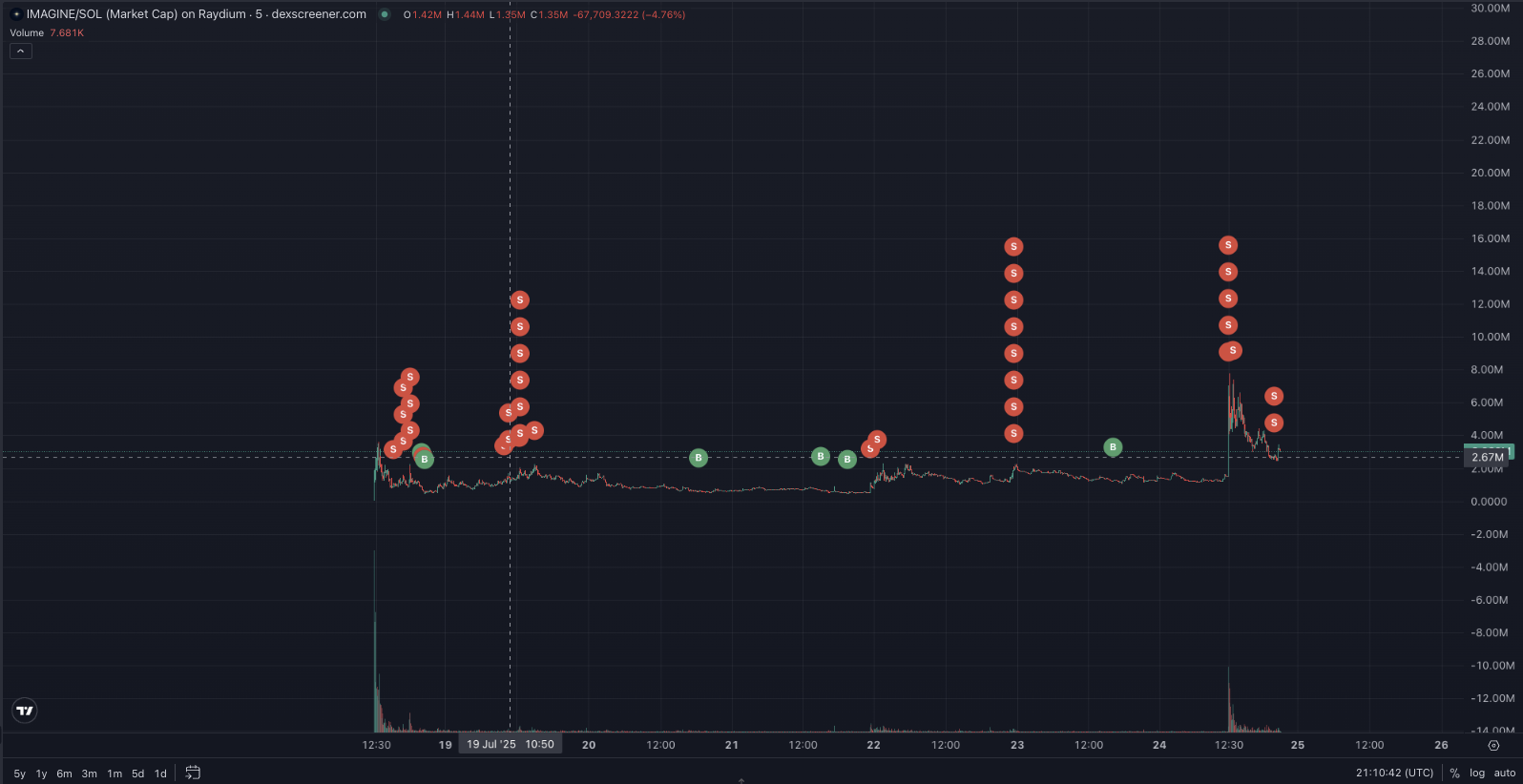
In the screenshot below, the chart is broken down into zones by date and size — to manually trace entries that aren't immediately visible:
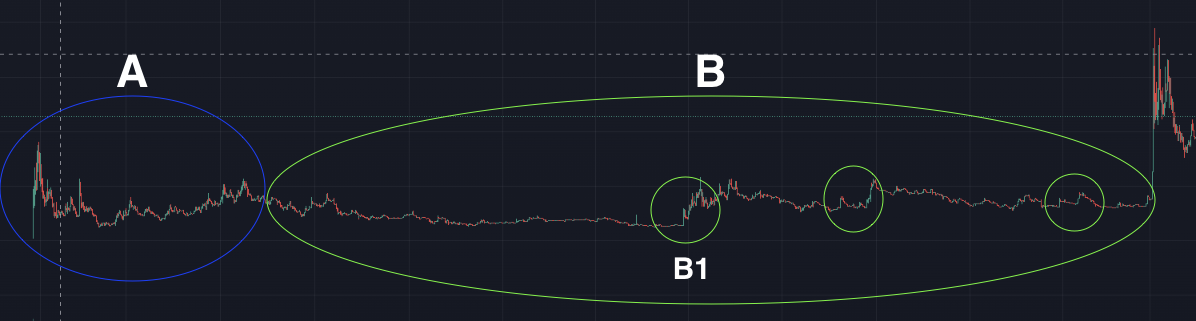
A) Initial Token Hype — At this stage, look for wallets that entered before the first breakout. These traders often spot trends early and are great candidates for Multi Buy setups.
B) Active Accumulation Zone — One of the most valuable sections: most participants have already exited, but a few wallets continue accumulating. This may signal a confident thesis and a well-planned strategy.
B1) First Sharp Pump from the Bottom — Usually triggered by some catalyst — a tweet, a chat signal, or insider info. It's crucial to identify who entered just before this move.
🟢 Small Circles in Zone B — These often point to scalping, buying dips, or a large player re-entering a position quietly. Identify which traders were active in Zone B and profited from the following pump.
Hints Inside Dexscreener
Dexscreener offers many hidden but valuable cues — if you know where to look.
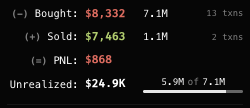
- Bought / Sold / PnL / Unrealized Profit — Show how much the wallet has spent, its realized profit, and any unrealized gains. These are your basic indicators for evaluating a trader's effectiveness.
- Token Balance — If the current token balance doesn't match the purchase/sell volume, it means some tokens were received or sent via transfers. This scenario requires further analysis.
- TXNS (Number of Transactions) — The more trades, the higher the chance you're looking at a bot or scalper. A moderate number of buy transactions is ideal. A high number of sells is fine — it may mean the trader is taking profits in chunks, which is a smart and normal strategy.
- Address Color Indicators — 🟩 Green = wallet is in profit. 🟥 Red = wallet is at a loss or has unrealized gains. ⚠️ Unrealized profit can sometimes still show as "in red" — these wallets should be manually verified.
What to Focus On:
Significant profit with noticeable investment — Confident entry, well-managed holding, and clear exit — this is a strong signal. Much more valuable than dozens of small scalps.
Unknown balance — Purchase is visible, but no or partial sales. If there aren't dozens of tiny transactions — this might be a hidden but high-quality trader not listed in Top Traders.
Synchronized purchases from multiple addresses — A sign of sub-wallets and automated strategies. These chains should be checked manually — they may point to a large player.
High unrealized profit — Even without selling, a large unrealized gain indicates a strong entry. Such traders often hold until the market is ready to move.
✅ Conclusion: Both surface-level and deeper analysis are important when selecting wallets to track. You need to clearly understand whether it's a quality trader with a repeatable pattern — or just someone who got lucky.
🔑 Don't chase quantity — signal quality matters more. RayBot will be powerful only if you add the best wallets. Verify, filter, test. Luck helps — but strategy and repeatability win.